
-Between Lavender and Linen – the Provençal interior style of my chambres d'hôtes, Mas l'Epicure
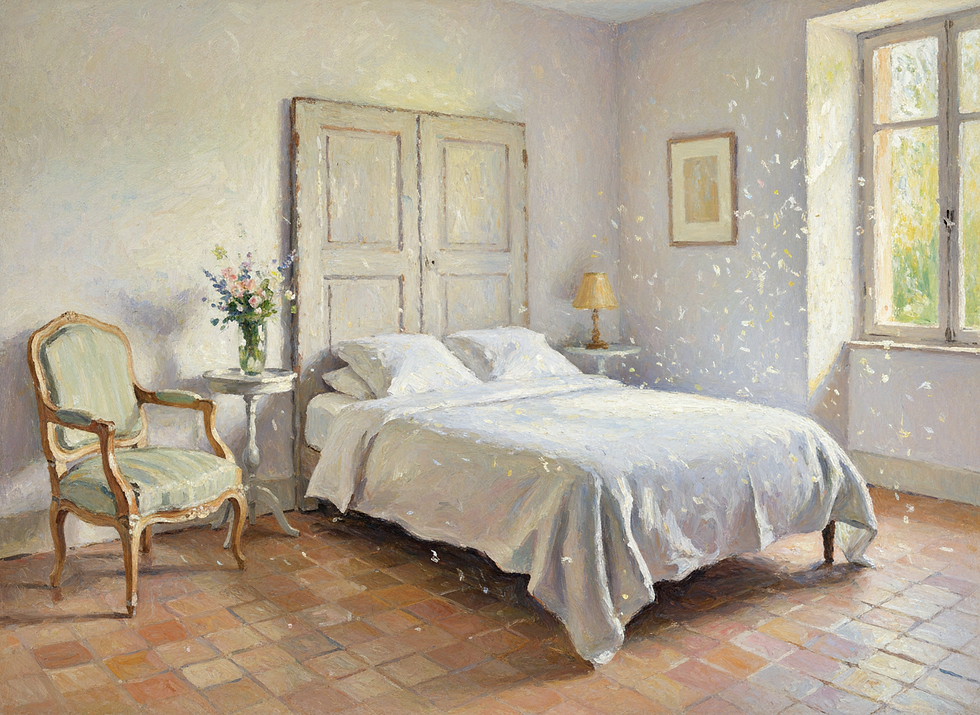
That softer, slower, and brighter Provençal light that filters through the windows in the morning, bathing every speck of dust in a quiet patience, is one of the things I love most about being here. It is a magical foundation that I feel compelled to emphasize.
What works for me and how to master the transition: "Between Lavender and Linen" – the Provençal interior style in my chambres d'hôtes, Mas l'Epicure.
I soon realized: these rooms didn't need more furniture—they needed more air. Fewer hard edges, more fabric. Less shine, more patina. I had images in my mind and more and more ideas began to take shape.
German clarity gave way to Provençal serenity, and my chambres d'hôtes found its own luminous whisper.
When I first moved into the house,
When I moved in, the rooms that were meant to become guest rooms already had their own bathrooms and toilets.
Everything was painted white and stood empty.
The bathrooms had dark brown washstands and built‑ins.
The fitted wardrobes were all made of dark wood.
Only the old, curved staircase leading up to the rooms still retained that beautiful Provençal colour and shape.
The space that is now the apartment consisted of two storage rooms with dark laminate flooring.
All of it was in desperate need of a transformation.
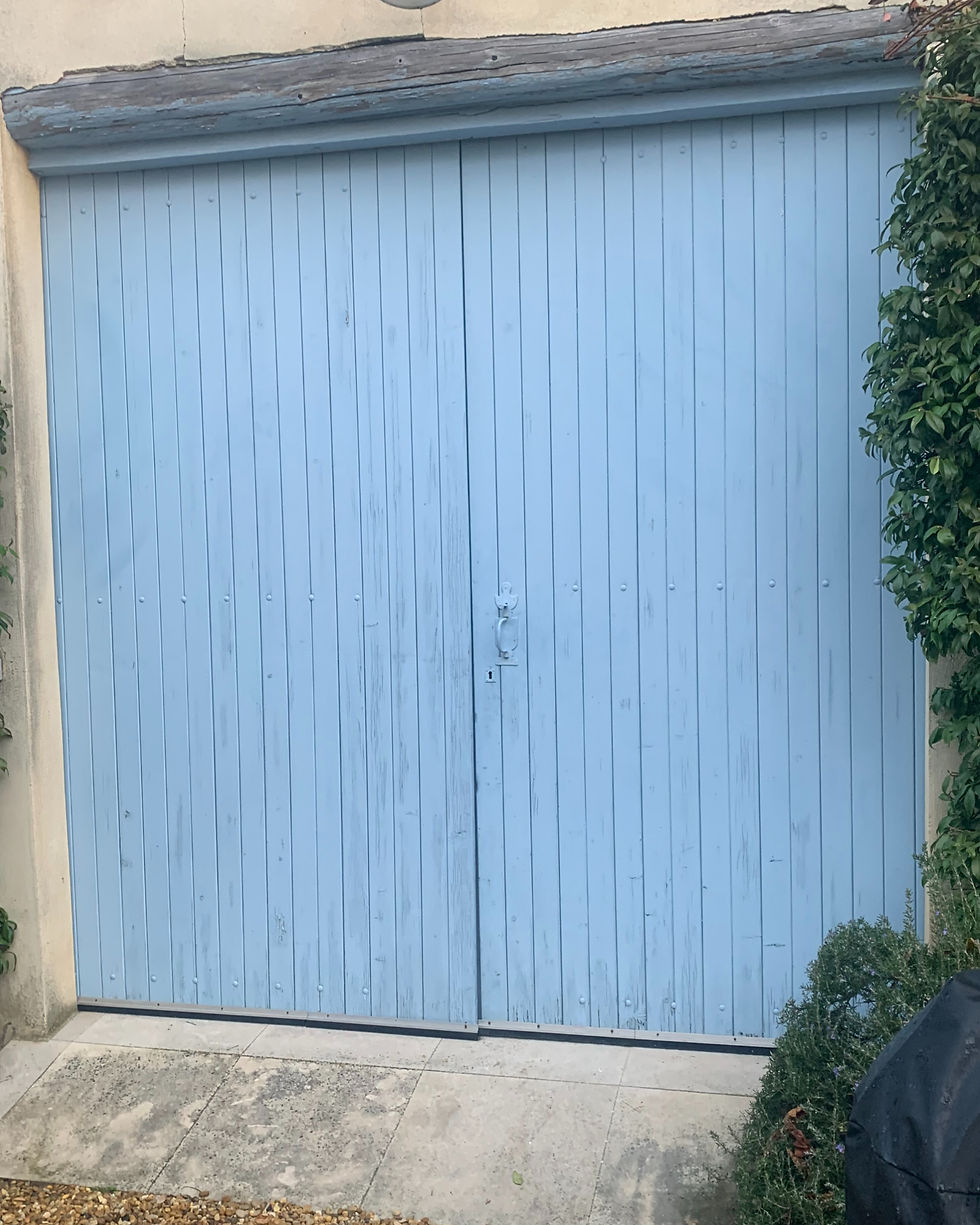
The solid extension to the 200-year-old house was also showing its age—a garage with an outdoor kitchen that lacked appliances and windows, closed off by a massive, double-leaf wooden gate.
My living area was one large room with a fireplace, and if every other room was to be a guest room, where was I supposed to sleep? There simply wasn't a room left for me.
This, too, had to change—towards a Provençal style, towards lavender and linen.
I couldn’t do it alone.
But I was lucky. With the help of my friends, Patrice and Fabie, I found a true all‑rounder. He moved in for three months, supported by a friend who had come from Germany. A language barrier, shortages of materials, bone‑chilling cold—yes, all of that.
We worked ten hours a day: construction, errands, cooking, planning, and hands‑on labour.
Admittedly, I was already quite exhausted, yet full of drive and lifted by ideas. I often lacked the serenity I needed, because I wanted nothing more than to open the doors as quickly as possible and finally earn money—money that was dwindling fast.
After three months, the structural foundation of the house was in place. I was on my own again and began shaping the colours and atmosphere of every interior room.
From straight lines to living surfaces
In the past, much of this old farmhouse was defined by straight lines and practicality: lacquered surfaces, cool woods, and very little contrast.
To begin the transformation, I focused on three key elements:
Color
Fabric
Light
The walls were given softer pastel tones that gently diffuse the daylight. Instead of high-gloss lacquers, I opted for matte, oiled woods, visible brushstrokes, and small irregularities.
It is astonishing how much more peaceful a room becomes when it no longer strives to be "perfect".
Linen became my common thread.
Pre-washed, delicate linen for curtains, bedding, and cushions; pastel shades—a palette that never imposes itself yet maintains a distinct presence.
To this, I added fine stripes, colorful and elegant textures, and the occasional leaf motif. Patterns are now a whisper, not an exclamation mark.
Brocante treasures: stories instead of novelties – pure Provence
It was the antique pieces that brought the true character. I have always been fascinated by the old—the way antique objects transition into the modern era.
I love it: the antique markets in Carpentras and Isle-sur-la-Sorgue, and the vide-greniers (literally "attic clearances") that take place in so many villages around here.


I head out early, equipped with a measuring tape, an open mind, and no rigid shopping list. I’m not looking for trophies, but for companions: a mirror with softly clouded silvering whose patina lends depth to a room; a wobbly chair that suddenly regains its poise after an afternoon of sanding and lime-waxing; lamp bases with personality, stripped of their heaviness by a new wicker shade.
What I look for:

Stability and proportions: Furniture should breathe, not dominate.
Wood and surfaces: Oiled rather than lacquered; naturally aged rather than artificially distressed.
Textiles: Scent, feel, and drape—linen is allowed to wrinkle, but it must never smell musty.
Electricals for lamps: Often rewired, so that charm doesn't come at the expense of safety.
And sometimes, it’s allowed to be truly colorful. Paintings in pastels—and I love pink, sometimes delicate, sometimes bold.
Room by room: small changes, big impact
Guest rooms
A simple bed frame with high-quality mattresses (my goodness, the money I spent on those!), a wooden headboard upholstered in ecru fabric—sometimes it's even an old door, softly patinated. Linen bedding in natural tones, definitely more pillows than strictly necessary, and a throw made of coarse linen.
On the nightstand, a small find: a lamp, a book about local markets, an old glass carafe with a matching glass.

The décor at Mas l’Epicure is anything but sparse—
a mirror with a charming frame, a painting that conveys a sense of lightness, an old soda bottle, antique furniture from the market in Carpentras, always aligned with that unmistakable Provençal charm.
Bathroom:
A bright aesthetic combined with comfort: simple chrome fixtures, baskets for luxurious towels, and a shower curtain that feels more like a sail than a plastic sheet. Skin-friendly soaps scent the air with lavender or citrus, but never too overbearingly.
I leave enough space so that the morning routine feels like a warm welcome, with feet nestled into soft bath mats.
The guest breakfast room, once an attached garage for heavy machinery:
With a large, inviting metal sign reading "Café des Amis" (Friends):
It was a real challenge to make the Provençal interior style felt here as well.
Once as dark as a hole, it now features a large sliding window front with electric blinds.
The massive gate has given way to an iron facade with insulated windows and doors. A newly built mezzanine with a wooden staircase provides space to store essentials.
And air conditioning, just like in the rest of the house. Keep in mind, this was still during the COVID era.
Furniture: A long wooden table with a set of antique chairs.
A modern kitchen featuring iron display cabinets with glass and high-end appliances.
A seating area with comfortable wicker armchairs—for me, it all comes together harmoniously.
Open shelving with everyday ceramics in white, ecru, and sage.
Now, served there with a great deal of love:
Fresh bread, homemade jams and yogurts, fruit, as well as tarts and cakes from my own kitchen, alongside local cheeses and ham. (Sorry, I simply couldn't resist including that).
You enjoy all of this from stylish plates and glassware, with the certainty that everything is fresh.
The backdrop is the sound of nature, drifting in through the wide-open sliding window and the iron door.
Here, Provence is no longer just a theme; it is the very atmosphere of the room.
Colors that don't shout – materials that tell a story: that is the Provençal interior style at Mas l'Epicure.
The palette is understated: warm tones, ecru, lavender-grey, a touch of pastel. Sage green makes a recurring appearance—on the walls, in a cushion, a bowl, or the shade of a table lamp.
Metals are quiet: aged, dark iron in delicate lines. Textures lead the conversation: linen, cotton, wicker, oiled wood, terracotta. The closer you look, the more there is to discover—not just as decoration, but as surfaces that have truly lived.
From a desire for order to a sense of serenity
The most profound change happened invisibly: I learned how to leave space.
For a long time, German clarity meant to me that everything must have its place.
Provençal warmth now means that everything has its own rhythm. A few books lie scattered as if someone had just been reading them. A window stays cracked open to let the scent of lavender drift through the rooms. Order, yes—but with soft edges.
Regenerate using:
Sustainability as a stylistic choice
Much of it is second-hand, some of it repurposed.
A chest of drawers became a vanity, an old door replaced a new one, and a linen curtain serves as a wardrobe door. I invest where guests truly feel it: mattresses, bedding, and quality lighting. When it comes to side tables and décor, my rule is: they must have a story.
Three steps that changed everything
Color: from cool to warm, from smooth to chalky.
Fabric: linen, linen, and more linen – floor-length curtains and bedding with a comforting weight.
Light: more lampshades, fewer spotlights, and dimmers instead of harsh overhead lighting.

An invitation to you, if you also love the Provençal interior style
Today, the rooms breathe. They don't just shine; they glow.
Between lavender and linen, my chambres d'hôtes, Mas l'Epicure, has found its voice and its very own Provençal style:
Bright, welcoming, and a little bit imperfect—just right for slow mornings and long conversations.
Come by and see for yourself; feel what it’s like when a German woman runs a guesthouse in Provence, and discover which impressions you’ll want to take home with you.
Do you feel it too—that sense of "between lavender and linen" in the Provençal style?
If you have any questions or would like some brocante tips,feel free to write to me:
Perhaps together we’ll find the piece that brings a sense of calm to your room.
Here is the link to my website, where you can see photos of how the rooms are styled.


Comments